
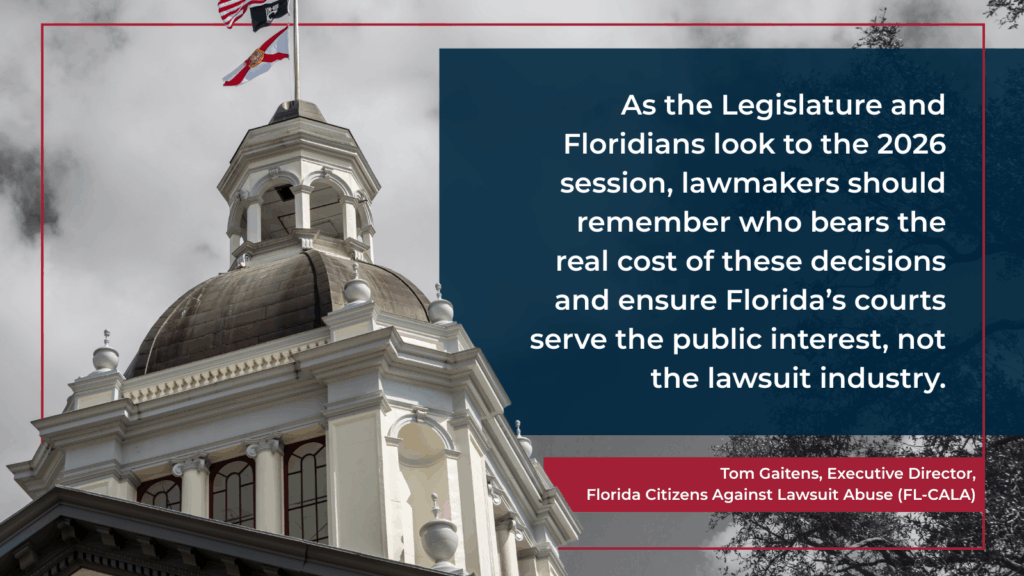
Tom Gaitens, Executive Director, Florida Citizens Against Lawsuit Abuse (FL-CALA)
Published
December 18, 2025
Recently, the American Tort Reform Association released its 2025-26 Judicial Hellholes® report, which was a sobering reminder of how quickly states can slide into legal chaos when lawsuit abuse is allowed to flourish. For Florida, the report should serve as both a warning and a wake-up call.
After years of hard-fought progress to escape the grip of a broken civil justice system, the Sunshine State now faces renewed pressure from the trial-lawyer lobby to reverse course.
With the 2026 legislative session approaching, the question is no longer theoretical: will Florida protect the reforms that restored balance and affordability, or will it risk tumbling back toward the very “Judicial Hellhole” status it worked so hard to leave behind?
The trial-lawyer lobby, empowered and emboldened by the state’s deep-pocketed billboard attorneys, has significantly tightened its grip on House leadership. Their agenda is unmistakable: dismantle the successes of the 2022 and 2023 tort reforms, revive the litigation mills that once plagued our courts, and restore the profit pipeline that depends on manufacturing and encouraging lawsuits at every turn.
Let’s be honest about how this industry works. Billboard attorneys do not thrive when disputes are resolved quickly, fairly, or inexpensively. Billboard attorneys thrive when lawsuits are plentiful, slow-moving, and expensive, regardless of the impact on consumers or taxpayers. Their model hinges on a system that is complicit with manufactured claims, inflated damages, and procedural gamesmanship. In a perfect world for the trial bar, the courts operate, not as a forum for justice, but as a profit center. When that system is left unchecked, the result is higher costs for families, higher premiums for small businesses, and a legal climate where accountability is an afterthought.
If House leadership chooses to serve the trial lawyer lobby rather than the people of Florida, the consequences will be severe. Reinstating inflated medical damages, reviving one-way attorney-fee statutes, expanding liability against local governments, and reopening the floodgates for insurance litigation will drive premiums higher, shrink insurer participation in our market, burden small businesses, and clog our courts with manufactured claims.
Thankfully, Governor DeSantis and the Florida Senate have remained the last lines of defense against this surge of self-interest masquerading as progressive policy. Their continued resolve will determine whether our elected officials wish to protect its citizens or capitulate to the greedy demands of a lawsuit machine. Florida does not need to relearn hard lessons it has already lived. The state’s recent progress should be protected, not unraveled.
As the Legislature and Floridians look to the 2026 session, lawmakers should remember who bears the real cost of these decisions and ensure Florida’s courts serve the public interest, not the lawsuit industry.